
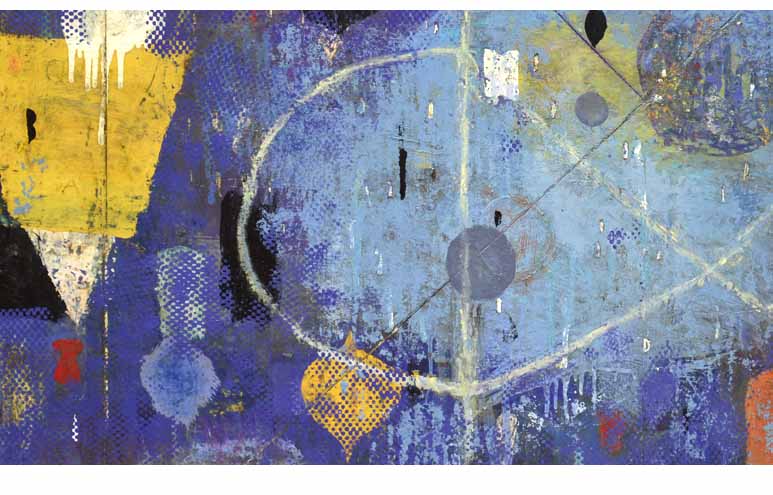
There is an understandable degree of concern embedded in knowing when our Art is done. Are we possibly overworking our Art? Or equally worrisome, maybe we are not pushing our Art far enough.
I often keep going way too long, invariably driving over that endpoint. I just don’t stop in time. I then end up creating an entirely new painting that still doesn’t have an endpoint. I feel I make 3–4 paintings that all could of ended before the 2nd or 3rd began. Overworking something is no fun at all. It also feels forever unsatisfying looking at your art that is just missing something. I know because I have done both.
Here are my three guidelines I use to help me know when I am done. I hope some of these might be helpful for you.
1 Your Art is strong up close and far away.
Your finished art not only looks strong from across the room but as you approach and get closer, it should also remain strong. The “loud conversation” – the bold marks, the high contrast of light and dark patterns – can be seen clearly from far away. These bold marks should be equally balanced by more subtle, minimally contrasting marks – “the quiet conversation” – that are only noticeable as the viewer gets closer to the artwork. Both views should be satisfying.
2 You have taken Risks to get there.
Sometimes I am trying to be done mostly so I can just feel done. However, stopping for this reason alone is never satisfying for the long term. Within a few days or even hours, I just know I needed to do more, push further even though that is hard sometimes to admit to myself. Like doing perfect swan dives off the low board, instead of the high dive, it just doesn’t quite feel up to par.
[Tweet “”Your Best Art shows more of yourself” – Nicholas Wilton”]
I only consider stopping when I have pushed into an area that feels different or new. I want to feel the aliveness that comes when you are participating in something entirely distinct. This work then becomes a little like a doorway leading to the next paintings, even though they are not even made yet. I look for that spaciousness, that embedded potential in all my finished paintings. If it is not there then I know I have not gone far enough.
3 Your Art feels like all of you
Looking back at the arc of my work I see now that my best work, the work that still holds something for me, seems to show more of who I actually am. These paintings are more holistic in this regard. In other words, you are not necessarily just showing what you can easily do, but also being truthful and allowing the work to show where you struggled, where you are unsure. There is a always a degree of vulnerability with showing the good along with the bad, but I have found its presence makes for much stronger artwork. It somehow feels more truthful, more complete.
It allows you to finally stand back and feel certain that this time, in fact, you are done.
How do you know when your Art is done?
In gratitude, Nicholas
14 Comments

Hi! I’m
Nicholas Wilton
the founder of Art2Life.
With over 20 years experience as a working artist and educator, I’ve developed a systematic approach that brings authenticity, spontaneity and joy back into the creative process.
Join me and artists from all over the world on our Art2Life Instagram account or learn more here about Art2Life.



Really helpful Nick. I try to use the “loud and quiet conversation” test you introduced in your workshops and it’s been very helpful when I feel unsure of what to do next. But deciding when a painting is finished is always a tricky one for me. Stopping and starting on multiple pieces—letting them rest and coming back to them helps me see the “finish line” more clearly. When I think a painting might be done or close to it I’ll bring it home to show my wife who has a great eye. If she thinks it needs more work then back to the studio it goes.
Well maybe this could be a new business for her–Can I too ask her when I should stop? Ha! that is great…it does really help to have objectivity!
Really helpful Nick. I try to use the “loud and quiet conversation” test you introduced in your workshops and it’s been very helpful when I feel unsure of what to do next. But deciding when a painting is finished is always a tricky one for me. Stopping and starting on multiple pieces—letting them rest and coming back to them helps me see the “finish line” more clearly. When I think a painting might be done or close to it I’ll bring it home to show my wife who has a great eye. If she thinks it needs more work then back to the studio it goes.
Well maybe this could be a new business for her–Can I too ask her when I should stop? Ha! that is great…it does really help to have objectivity!
This must be a universal question so it’s great to hear you address this, Nicholas! The longer I paint, the more able I am to recognize when a painting is done. When I begin a painting, it is just putting paint down, getting momentum going, causing actions and reactions to occur which hopefully begin a kind of conversation between the painting and me which gets louder and louder as things are happening. A brighter color here, a gray there, less texture, more texture, too much, too little, etc. It seems there is a peak in this type of conversation as the painting progresses–usually days or weeks. As changes are made, the conversation gets more and more quiet until there is a certain peace and quietness. Perhaps at this time, the painting is done, but every day the painting is revisited and seen as new, giving the painting many chances to “speak up”. If, however, the calm remains, I leave it alone and know the battle is over and the painting is done–at least for now. As much as I appreciate paintings which evolve from great struggle, I am also trying to recognize that spontaneity and freshness can, in itself, be a sight to behold. This means there can be newness in an approach, a small triumph that comes from reaching out with new materials, etc. and then I sometimes stop earlier, not pushing too much if early gestures are strong, the loud and soft conversation are there, and I want to remember that particular moment in time. This is when I appreciate that all the experience behind me sometimes produces a “gem” not from all the time spent pushing the surface, but from all the information, struggles, wins and losses of the past. These moments are rare, but nonetheless, they, too play a part in showing an important part of the soul.
I think that is interesting what you say about letting the painting tell you it is done –like it will speak up over the following days once you think it is done…they do have a life of their own. Well said!
Quick thought. I think there can actually be more than one “stopping point” in a painting. Where we end up is where we are in our life’s journey. A painting I paint today would most likely look different from the same painting done a little further down the journey of life. Like a subway train, it’s when we decide to jump off, or whether we decide to keep going and explore a little further. Perhaps the more we know, the further we go, or the earlier we stop?
Thought I’d share this image of an encaustic painting (24x24in) which, as always, was a “journey” of decisions, doubts, hopes, and sometimes excruciatingly difficult choices to push out of my comfort zone. There were many areas I loved which I had to cover up in order to save the “whole”. Is it done? For now, the conversation has quieted down, but that doesn’t mean it will stay quiet 🙂 In the encaustic medium, I am trying to play more with lost and found edges (as in the large black “8”) and push the feeling of depth. One thing I need to change is the solid dark triangle in alignment with the red rectangle; need to overlap the red rather than run a tangent! What next! Your feedback is always welcome! Pam
This must be a universal question so it’s great to hear you address this, Nicholas! The longer I paint, the more able I am to recognize when a painting is done. When I begin a painting, it is just putting paint down, getting momentum going, causing actions and reactions to occur which hopefully begin a kind of conversation between the painting and me which gets louder and louder as things are happening. A brighter color here, a gray there, less texture, more texture, too much, too little, etc. It seems there is a peak in this type of conversation as the painting progresses–usually days or weeks. As changes are made, the conversation gets more and more quiet until there is a certain peace and quietness. Perhaps at this time, the painting is done, but every day the painting is revisited and seen as new, giving the painting many chances to “speak up”. If, however, the calm remains, I leave it alone and know the battle is over and the painting is done–at least for now. As much as I appreciate paintings which evolve from great struggle, I am also trying to recognize that spontaneity and freshness can, in itself, be a sight to behold. This means there can be newness in an approach, a small triumph that comes from reaching out with new materials, etc. and then I sometimes stop earlier, not pushing too much if early gestures are strong, the loud and soft conversation are there, and I want to remember that particular moment in time. This is when I appreciate that all the experience behind me sometimes produces a “gem” not from all the time spent pushing the surface, but from all the information, struggles, wins and losses of the past. These moments are rare, but nonetheless, they, too play a part in showing an important part of the soul.
I think that is interesting what you say about letting the painting tell you it is done –like it will speak up over the following days once you think it is done…they do have a life of their own. Well said!
Quick thought. I think there can actually be more than one “stopping point” in a painting. Where we end up is where we are in our life’s journey. A painting I paint today would most likely look different from the same painting done a little further down the journey of life. Like a subway train, it’s when we decide to jump off, or whether we decide to keep going and explore a little further. Perhaps the more we know, the further we go.
Thought I’d share this image of an encaustic painting (24x24in) which, as always, was a “journey” of decisions, doubts, hopes, and sometimes excruciatingly difficult choices to push out of my comfort zone. There were many areas I loved which I had to cover up in order to save the “whole”. Is it done? For now, the conversation has quieted down, but that doesn’t mean it will stay quiet 🙂 In the encaustic medium, I am trying to play more with lost and found edges (as in the large black “8”) and push the feeling of depth. Your feedback is always welcome! Pam
Haha! I do the same…have a few paintings or several paintings buried under the one final painting because I haven’t stopped in time. And around and around we go! Very annoying as I can’t go back! Anyway, what I really want to say is I have no idea by what miraculous chance I fell on your site and signed up for your newsletter but I’m so happy that I did because I love getting your viewpoints in my mailbox every week!
Haha! I do the same…have a few paintings or several paintings buried under the one final painting because I haven’t stopped in time. And around and around we go! Very annoying as I can’t go back! Anyway, what I really want to say is I have no idea by what miraculous chance I fell on your site and signed up for your newsletter but I’m so happy that I did because I love getting your viewpoints in my mailbox every week!