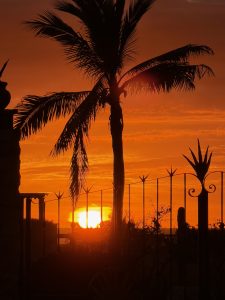
In Baja, Mexico, in the late afternoon, everything goes this beautiful shade of gold. The sky, the doors, the surfboards, the plants. Every color takes on a hazy, warm richness I’ve never seen anywhere else in the world. I’ve been going to Baja for years and always been drawn to it intuitively. But it wasn’t until this last visit that I finally understood why. And more importantly, I finally figured out how to bring that quality into my paintings. In this post I share the technique and the thinking behind it.
______________________________________
The Color I’ve Been Chasing for Years (And How I Finally Learned to Paint It)
In Baja, Mexico, in the late afternoon, everything goes this beautiful shade of gold.
The sky, the doors, the surfboards, the plants. Every color out there takes on this hazy, warm richness that I’ve never seen anywhere else in the world.
I’ve been going to Baja for years and I’ve always been drawn to it intuitively. But it wasn’t until this last visit that I finally understood why.
It’s not one thing doing it. It’s something underneath the color. Or maybe in front of it. Walls painted over year after year, patina building on patina, until the red isn’t one red. It’s like a hundred reds stacked on top of each other.
And sitting there, watching the light drop toward the sea, I realized something.
This is what I’ve been chasing for years in the studio. Without ever being able to name it.
What Baja Has Always Been Trying to Show Me
Before I get into the technique, I want to sit with what I actually saw out there. Because I think the observation matters as much as the method.
Color in Baja doesn’t feel flat. It never feels like one thing. Even a simple painted wall carries depth and history and a quality of time that you can feel without being able to explain.
That’s the patina.
Walls painted over year after year. Layer on layer. Each coat of paint slightly different from the last. Fading differently. Wearing differently. So that what you’re looking at isn’t a single color but the accumulated history of every color that’s ever been there.
And the late afternoon light hits all of that at once. Not illuminating it so much as warming it. Pulling the depth out of everything it touches.
I don’t know if it’s the dust in the air or the particular angle of the sun dropping toward the Pacific. I just know I’ve never seen anything quite like it anywhere else. And I’ve been trying to get it into my paintings for years without ever quite landing it.
This last trip I finally understood what I was actually chasing. And once I named it, I knew exactly how to get there.
What I’ve Been Reaching For Without Knowing It
Here’s what I realized sitting on that Baja street watching the light change.
Color becomes most alive not when it’s flat and bright and pure, but when it feels like it’s been somewhere. When it carries
the evidence of time and weather and layer upon layer of something that came before.
That’s what a patina is. Not a technique exactly. More like a quality. A feeling of depth that can’t be achieved in a single pass because depth by definition requires more than one moment.
The pure tube color straight from the paint is just one thing. Beautiful but singular. It hasn’t been anywhere yet.
The color I keep chasing in Baja has been everywhere. It’s been through seasons and dust and sunlight and shade and every color that ever lived next to it. It has a history you can feel without being able to read.
That’s what I want in my paintings.
And I finally figured out how to get there.
The Technique: Pastel Over Acrylic
Here’s the thing that surprised me when I finally put it together.
The tool I’ve been reaching for intuitively for years, without fully understanding why, is pastel.
Most of my work starts in acrylic. I build the painting up in layers of acrylic paint, working toward something I like. And then, almost always, I reach for the pastel.
I used to think I was reaching for it because of the color. But that’s not quite it.
I’m reaching for it because of what it does to the color underneath.
Pastel is a dry pigment. When you layer it over a painted acrylic surface it doesn’t cover what’s there. It skips across the texture. It settles into the low points and sits on top of the high ones. It influences the color without replacing it.
And that influence, that layering of something dry and chalky over something painted and built, is what creates the patina quality. The color stops being flat and bright and singular. It starts feeling worn. Dusty. Like it’s been somewhere.
Like Baja in the late afternoon.
How I Actually Do It
Let me walk through the process because there are a few practical steps worth knowing.
Start with your acrylic painting. Build it up the way you normally would. Get it to a place where you like the color and the surface before introducing the pastel. The pastel works best as a response to what’s already there rather than as a foundation.
Layer the pastel over the dried acrylic surface. You’ll notice immediately how it skips across the texture. It’s not covering the color underneath. It’s sitting on top of it, influencing it, adding a layer of something slightly different in temperature or value or hue. That gap between the pastel and the acrylic underneath is where the depth lives.
Spray fix the pastel. This is the step most people skip and it’s the most important one. Pastel is a dry pigment and without fixing it will wear off over time. I spray fix it lightly, which does darken it slightly, and then let it dry completely before moving on.
Seal with gloss medium. Once the spray fix is dry I seal the whole surface with gloss medium. This locks the pastel in permanently and essentially converts it into part of the acrylic painting. Once it’s sealed it’s not going anywhere.
Come back in with more paint. This is the part I love most. Once the pastel is sealed I can paint over the top of it again with acrylics. And now I’m building another layer over something that already has depth and history. Another coat of paint over a surface that’s already been somewhere.
Layer by layer the painting starts to accumulate that quality I was watching on those Baja walls. The color stops being one thing. It becomes a hundred things stacked on top of each other.
Here is the kind of pastel fixative that I use:
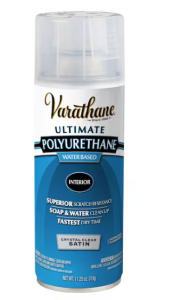
RUST-OLEUM Polyurethane Spray: Varathane, Urethane Floor Coatings, Water, Polyurethane, Base, Clears.
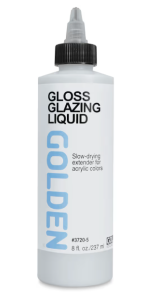
and the second more permanent way I seal the pastel is by using any gloss medium acrylic coating. Here is the one I like to use:
Golden Acrylic Glazing Liquid
Color as an Emotional Doorway
I want to say something about why I think this matters beyond the technique.

Color is an emotional way into the deeper part of myself. That’s how I experience it and that’s how I use it in the work.
When a color feels flat and singular it communicates one thing. When it feels layered and worn and built by time it communicates something else entirely. Something richer. Something that resonates at a frequency that bypasses the analytical mind and goes somewhere deeper.
That’s what Baja has always been trying to show me.
Not a color. A quality of color. The difference between what something looks like and what it feels like to have lived next to it for years.
That’s what I’m after in the studio. And the pastel, layered over the acrylic, sealed in and then painted over again, gets me closer to that quality than anything else I’ve found.
Come Find It With Me
This November I’m heading to Palmaïa, Playa del Carmen, Mexico with a small group of artists. November 6th through 13th.
If you’ve ever wanted to sit in that late afternoon light and watch everything go gold, to paint in a place where color itself seems to do half the work for you, I’d love to have you join us.
Click here to learn more about the Mayan Riviera retreat and see if it feels like a yes for you.
Now It’s Your Turn
Is there a place whose quality of light you keep chasing in your work? A color or an atmosphere you’ve been trying to get into your paintings without quite landing it?
Share it in the comments below. I’d genuinely love to know what light you’re chasing and where it lives.

Hi! I’m
Nicholas Wilton
the founder of Art2Life.
With over 20 years experience as a working artist and educator, I’ve developed a systematic approach that brings authenticity, spontaneity and joy back into the creative process.
Join me and artists from all over the world in our Free Art2Life Artists Facebook Group or learn more here about Art2Life.