
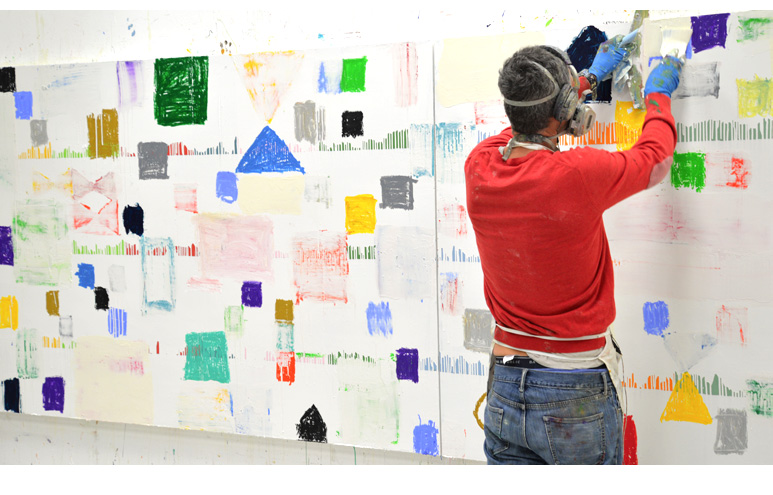
When you make a mediocre painting bigger it just gets more mediocre. I sure know this feeling and I don’t like it. However when you make something powerful AND it happens to be bigger then it can become breathtaking. Making art bigger than ourselves can be challenging. But it doesn’t have to be.
Here are three easy ways to make your Art bigger and better.
#1 MAKE THE CLOSE UP VIEW AS STRONG AS THE DISTANT VIEW
When art that is bigger than yourself, it is important that the art looks exciting, not just from close up, but also from across the room. Sometimes when our Art is large, we stand right up close and get lost in all its detail. However, from a distance the viewer can’t see these subtleties. If it doesn’t look interesting from a distance then no one will spend the time walking across the room to look at it. A strong work of art needs amazing detail, subtlety (close up view) juxtaposed with bold, loud composition or interest that can be seen from far away (Distant view.) Both aspects need to be equally strong.
This idea can be easily seen in Georgia O Keefe’s painting “Horses Skull with Rose”
I like to think of how my art would look to someone driving by a gallery in a car traveling at 25 mph. If, that one second, distant view is compelling, then and only then will the driver pull over and come into the gallery to have a look at my work.
#2 SCALE UP YOUR TOOLS AND MARKS
When the work gets bigger, then so should the tools used to make that work. Imagine a 1” brush being used on a 12” square painting. The brush relative to the size of the art is quite large. Now if you make that 12” square painting 72” x 72” square, it has grown in scale 36 times! Taking a brush only slightly bigger, say 2” will in no way be enough to generate a similar powerful brushy feeling of the 12” painting. Basically, going larger with your tools will help you scale up the feeling you achieved in the smaller work. I was amazed at the scale of tools Gerhard Richter used to produce his amazing “Cage Paintings”
Also, what might be a bold gesture, done with a twist of the wrist on a smaller work might not be enough once the work becomes larger. Your emotion and the physical movement of mark making have to also grow in scale to pull off larger work. Larger tools will help you achieve larger work.
#3 MAKE YOUR THINKING BIGGER
When working on your Art, especially something at scale, it is important that you push yourself to think beyond the confines of the edges of your actual Art. Imagine that your art is merely a window into something bigger. Imagine you are creating a cropping of something that is bigger as you work. A shape that is made while worrying about the actual boundary of the art will feel small and self-conscious compared to one that ignores or is not aware of the physical edges of the Art.
Sometimes I like to start my painting outside the panel I am working on. It invariably makes a more powerful statement. Large work doesn’t work if your thinking remains the same as when you were working on something small.
Be expansive in all ways so that your art will not just look large but will feel large as well. It needs to be both.
These are some of the ways that have helped me work larger. What ways or thoughts do you use to make your Art bigger? Please comment below.
15 Comments

Hi! I’m
Nicholas Wilton
the founder of Art2Life.
With over 20 years experience as a working artist and educator, I’ve developed a systematic approach that brings authenticity, spontaneity and joy back into the creative process.
Join me and artists from all over the world in our Free Art2Life Artists Facebook Group or learn more here about Art2Life.

That’s Matisse – not Picasso – but like the idea of starting the painting outside the panel you are working on……
great ideas
Sorry but the photograph is of Henri Matisse drawing in his studio not Picasso.
Yes of course, Matisse—thanks…I love how he used a stick to be close up but also far away at the same time…
I paint large and expressively, and your suggestions are very helpful. Going to small from large is my problem. I am often asked to donate small works (6″-9″) to charitable, local exhibitions. It is always frustrating for me. Any clues how to go from large to small?
That is interesting…I would just get small brushes and treat the small panel as a sketch for the bigger one…sit down and work at a table so you are close up…I like doing small work as they can be inspiring for larger ones…
Thank you, this is very helpful!
So glad–N
I once went to a museum talk with Squeak Carnwarth. She talked about instructing her students to work on canvases that are larger than they are. The purpose is to move beyond the small box of familiarity.
Great article. I have been painting quite small butI’d really like to go BIG! I’m nervous about the trasnfer of scale, quantity of paint etc butthis has helped give me some pointers – specifically about long and close-up vision. Very helpful when someone else puts into words just what you have been thinking – thank you!
All of these blog entries and comments are so helpful to me, a beginner who thinks she might have some talent in interdisciplinary art/education.
Such good advice here, I am going to do it all. I actually like to be so wowed by my immediate first response to an art work, that it is like someone pushed me. Or in the case of the guy driving the car above…I crash the car….but funny, like into a watermelon stand. Then I run into the gallery.
I love crashing a car into a watermelon stand–that conjures up a car crash but no one ever gets hurt when you crash into a watermelon stand..you got something there–ha! love it–thanks
You can also make your art bigger by using Artkido. We reproduce art into large, hand painted replicas that’s gallery quality.
I have just started making larger paintings for a show that I am having in the Fall. What you wrote is very helpful. I can see that I am going to put more of my body then my mind into these new pieces. After I have done a sketch for a painting I put it away and just begin the larger piece. I draw on the canvas and use the sketch to depart from, how the painting turns out depends on my being able to step away from it and see it from different perspectives. In this way I have been able to see how some paintings are more successful then others. Thank you for your helpful advice, I very much enjoy reading what you have to say.