
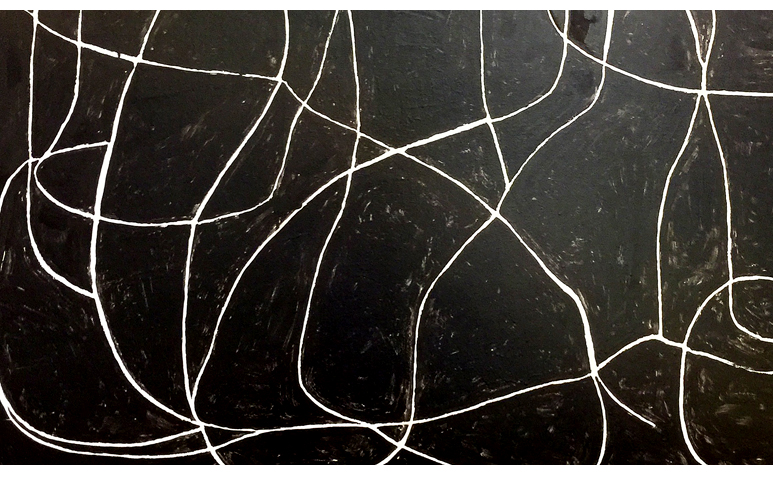
 I think the main challenge in art making is remaining objective. How do you totally focus on this thing you are making—a painting, sculpture etc. without losing your objectivity? We need to see it as it appears for the very first time even though we have been staring at it for weeks. If we can see it clearly we have a better chance of improving it by the changes we make.
Here are a couple things I do:
1 I rarely work on something for more than 2 hours. I try to stop closer to an hour for maximum efficiency in my art process. I do my best work in the first hour almost every time.
2 I Post on Instagram what I am making. That forces me to see it small. Once I see it in my Instagram feed I can see it in a way I haven’t before.
3 Allow some distractions, like music, podcasts, and even visitors to interrupt you a little. I find my work is more easily made when I am not allowed to overly focus and obsess.
4 I turn my painting upside down and change the design so it works upside down. Then I flip it over again and re adjust for that orientation. I do this constantly. Each time I change it for one direction it improves it for the other. IN the end my picture can work either way, and then I know it is balanced.
5 I always work on 4-10 paintings on my studio wall. Not necessarily at the same time but I do jump around and I can always see all of them. Seeing so many makes it harder to obsess over one.
What do you do to remain objective? Lets start a list from all our comments…I will compile it and post it in FB and back here next week as a download. This could be super helpful to all of us!
Thanks in advance for all your comments. I read every one even though sometimes I can’t respond to all of them. I am painting a lot right now as I have a solo show coming up at Caldwell Snyder Gallery in San Francisco! The opening is Thursday, 5:30- 7:30 April 6th. If any of you are up here then I would love to see you!
Nicholas Wilton
PS The image above is a cropping of one of my father’s paintings. You can see his work at cliffordwilton.com
35 Comments

Hi! I’m
Nicholas Wilton
the founder of Art2Life.
With over 20 years experience as a working artist and educator, I’ve developed a systematic approach that brings authenticity, spontaneity and joy back into the creative process.
Join me and artists from all over the world in our Free Art2Life Artists Facebook Group or learn more here about Art2Life.

This article makes me feel so much better!! I usually have 2-3 projects going on at one time from painting..A mosaic..Pencil drawing. It keeps me from getting bored and allows me to see a fresh perspective.
That is it!
This is so very helpful. Thanks for sharing the nitty gritty details about your process. Gives me permission to work on more than 2 paintings at a time!
OH yes!!! Permission is granted! I seriously could never do one painting at a time!
Thanks so much for the encouragement!
How long(days/weeks) will the show last?
It is up for about a month Tresa…
I like having my dog hang out in my studio. I have set up a bed for him to hang out, nap, and watch me work. It’s nice to take a break and have a snuggle session with him.
As always, your tips are very helpful. Thank you
You are welcome!
To remain objective and to work on problem pieces, I hang paintings in various places in my home so I catch a glimpse of the painting from all different angles and then things jump out at me and I get ideas on how to improve. Sometimes I have problem paintings hanging for months before I am ready to work on them again.
Oh that is great too!
I take a photo of the piece and download it to my Mac. There it shows as a tiny thumbnail on the desktop, which I can open and size it a bit larger on the screen if I want to see more detail. Seeing it smaller always makes the values more important than the color, helping me see how they are working.
I will sometimes turn my back to the painting and look at in a mirror over my shoulder so I see it backwards. That can be VERY telling….!!
Yes!!!
I like the idea of limiting to one hour… I can overwork and then have to recover….
To remain objective 1) turn around my piece frequently, 2) photograph it at various stages, 3) Listen to music or have something on in the background to loosen myself up and 4) step away from it when I start feeling tired or frustrated…I would like to become more proficient in photoshop so I can play with my pieces there…For now I often cut out pieces of light/dark paper and place them around the board to see how they fit in the overall design.
Oh forgot to mention that I love the crop of your father’s painting!! <3
If you have the space in your studio, walk a long way back from the work and evaluate it from a distance. Move paintings outside if that’s the only way. I find that leaving the work for a break and then doing this is very helpful.
Sometimes I take one additional step which can help me. I take photos of all my work in progress and I take a break at the computer as soon as I feel a lag in flow. I’ll check Facebook and email for 5 minutes (restraint needed) and then with fresher eyes I take look a at the photos on the computer. When I open all of the images in Photoshop with the black background, they look new to me and I immediately see changes I want to make. If I am unsure I will try a few things on a layer in Photoshop and click it on and off to see how it looks with and without quickly. If it’s a shape I am working with placing I can move it around in Photoshop. As I gain confidence I am doing this step less, but it helps me get a new perspective. It is also a familiar way for me to work since I did collages for years where I could place shapes and move them around at a whim! I save all of the photos of each painting in a folder so in the end I have an interesting history of each piece.
Thank you, Nicholas – those tips are very useful indeed! Must especially remember the one about only spending an hour at a time, as I tend to keep working too long on a piece. Also, thank you for sharing your father’s website. I like his art very much – such a broad range of work. Nice to see photos of him, whom you resemble closely.
I work with mostly bright, saturated colors. I find it helpful to take a photo of the painting with my iPhone and edit it so that it’s just in black and white. This shows me just the values and I can see where I might need to boost up the contrast. Thank you for sharing your insights, Nicholas!
Thank you for sharing your thoughts about art making. With my paintings I work on a flat surface because my paint is so liquid, but when dry I hang the work on a wall to really look at it and to also photograph it. Just like your instagram image, the photo helps me to see what is and isn’t working. I love both your and your father’s abstract paintings.
Nicholas, I am prepping to paint larger than I ever have. One problem, I need to protect the walls when I hang pieces to paint on them, especially after seeing your demo of painting off the edges of your surfaces. Do I cover them with plastic? Any tips on how best to do that? Do I buy 4′ x 8′ thin plywood panels and nail them onto the walls? I would appreciate any suggestions you or other artists can offer. Thanks!
Hi Jeanne — I’m interested in this question, too. I just recently rented a studio outside my home and I want to protect the walls. One artist I know tapes thin plastic drop cloths to the walls. Another uses thin clear shower curtains — she hangs them from the gommets and the weights on the bottom keep them taught when taped to the bottom edge of the wall. If you hear of other solutions, let me know. Thanks!
Diane, I tried heavier plastic and the painters tape kept pulling away from the wall after a day or too. Thinner plastic makes more sense. The shower curtain idea could be an option — what does the artist you know put through the grommets at the top so they don’t slide off? Some sort of hooked screw?
She said she put in 3 screws into the studs of the wall, and hung the grommets from them. Taped all four sides to the wall.
If you were going to use plywood panels, I would screw them into the studs, not nail them into the walls.
Thanks Diane I will try the drop cloths first then the screws and shower curtains if those don’t hold up! I’ll let you know how it works out!
I listen to light crime fiction audio books. I’m careful to stop listening when the paintings are further along (I found that out the hard way!) but in the early stages I find keeping my left brain busy with the words and story allows my right brain free rein.
I just start in. There are over a dozen paintings going right now in my studio and although I thought I had a basic idea of how they would look, as the group develops, little shifts occur which impact all 12. Go with the flow!
I’m so happy to read I’m not the only person that flips my paintings around when I’m working on them. I found I like the results and don’t get “stuck” when I do that. I so wish I had room to have multiple paintings to work on since I agree about 1 hour and then I have have to move off a piece or I’ll just overwork it.
I think all the things I do have been covered in the comments. I do have a funny story though… before I had a large studio I worked on two 3’x8′ paintings in a small room that used to be a porch. They just fit under the ceiling. When I tried to step back to get a better perspective, there wasn’t enough room. I had to run outside and look in the windows at them 🙂
Nicholas your topics are so timely and your sharings are specific and very helpful. Thank you! I often spend much more than two hours at a time on a single painting. One of the reasons is that I’m very particular about the colors that I mix. The bulk of my painting time is usually spent mixing. And because I use large amounts of paint combined with gel medium, mixing it all even in stages is a project in itself. Any thoughts on that? If I am working on 2-3 paintings at once, I could still easily spend 6-8 hours if I had that much time. I think I hear you suggesting to cut back on that, even when working on multiple paintings in one “sitting.” Is that correct? Thank you also for honoring your father by sharing this image.
After the CVP, I moved to a larger space. I now have 5 canvases up. I start warm up on the 12×12’s…then move to the larger paintings. Back and forth. I am generally work a couple of hours, rarely longer. If longer with long breaks in between. I am more productive when I warm up with small paintings then move to the larger ones … maybe only 1 a day. I like looking at them ‘fresh’ when I come back to the studio. What is new is working on this many at a time. I like it a lot. I especially like ‘stopping by’ and working on a canvas without the guilt I used to heap on myself.
Sometimes I use a mirror and look at the image over my shoulder in the mirror. It helps with balance quite a bit. Scjattering the work around the house so I suddenly come across it as I enter a room, helps give me a fesh perspective. However, I have managed to completely lose one of my paintings because I forgot where I put it and it took me simply ages to find it again!