
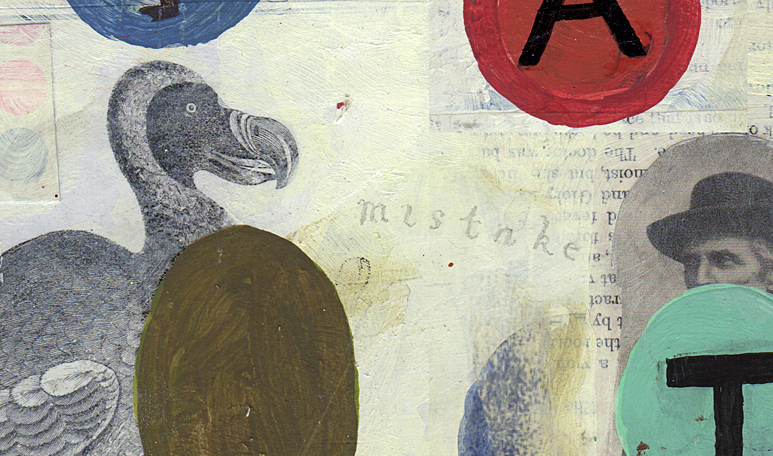
 Sometimes life just seems like a long stream of corrected mistakes. I am not sure why we get so frustrated after the umpteenth time we have made an error. You would think we would learn and accept the fact that the mistake is simply inevitable.
Making Art has helped me understand, accept and actually embrace my fallibility. On the first day of the ArtLife workshops I used to emphasize that it is perfectly ok to make mistakes. Everybody does. Lately, however, I have become clearer not only about the inevitability of missteps but the necessity of them. I now propose that making mistakes are actually essential, a vital component of strong Art; it just simply can’t happen without them. There always seems to be a collective sigh of relief in the room once I remind everyone of this fact. Of course we all know this to be true but maybe don’t always remember why.
I believe there are basically 3 Reasons why mistakes improve your Art.
[Tweet “”In Art, being wrong can pay off big time.” – Nicholas Wilton”]
Mistakes provide Authority.
Making Art is a practice, a lifetime journey from the moment you begin making art till the very day you stop. The success, the discoveries found along the way, is demonstrated by the progression of your artwork. There are millions of decisions that go into every single piece of art you make. The more decisions made in making your Art, I believe, the better you become at your Art. Your decisions are either correct or incorrect. If they feel right, they remain, but if not, then another decision is made in its place. And this one, this second decision, because it is derived in response to a prior incorrect one often expresses more refinement and more authority. These 2 part decisions are the ones that matter most. They can dramatically embolden your work. In Art, being wrong can pay off big time.
Mistakes make Correct more Correct.
Much of the power of Art is derived from the visual, auditory or conceptual differences presented. The viewer is made to feel something, or to see more clearly an idea that the artist has made more apparent. This is often achieved by the juxtaposition of opposites. An example of this would be a large shape next to a tiny one or a saturated color in close proximity to an unsaturated one. Allowing the evidence, the subtle remnants of a correction – an erased pencil mark for example – provides a perfect complementary setting for a correct, decisive one. The correctness, the confidence of the final mark is made even more so by the prior mistake. As a result the work overall is enhanced.
Mistakes allow others to access you.
Your Art, once completed, stands as an open invitation to anyone who is interested. There is a humility, an honesty that emanates from work that achieves success through struggle. When we feel the artist’s humanity, her decision making, it becomes an access point for the viewer. The bridge between artist and viewer becomes closer. There is almost a universal appeal for persistence, for the dogged pursuit of desire. The struggle inherent in work, the history of right and wrong turns, gives it maturity, and a level of depth and intrigue. This quality broadens the authenticity and therefore the accessibility of your art.
In the end, it is comforting to know that at least in the area of art making, nature is on our side. We seem hard-wired to make mistakes again and again. Thankfully, we can learn to become more sensitive and more refined in how we correct, how gracefully we can right our boat, and then, in front of all who are watching, set our sails and begin again.
What has your experience been with mistakes? Do you think we learn from them, or is the relationship something else?
In gratitude, Nicholas
6 Comments

Hi! I’m
Nicholas Wilton
the founder of Art2Life.
With over 20 years experience as a working artist and educator, I’ve developed a systematic approach that brings authenticity, spontaneity and joy back into the creative process.
Join me and artists from all over the world in our Free Art2Life Artists Facebook Group or learn more here about Art2Life.

Your newsletters are always a big help to me. Somehow, you manage to put into words what, as an artist, is often difficult to even figure out what is happening in front of us. I feel you are capturing something universally true here, and I couldn’t agree with you more that mistakes are normal and must occur. What is most comforting to me is knowing that even the very successful artists continue to make mistakes, or, perhaps that is why they are so successful and beloved for their willingness to let others know they are not perfect! Thanks, Nick.
Hi Nicholas, your art is amazing and wonderful and your writing is so profoundly true to me. Thank you! As my 6 year old my son watched me paint he called my process ‘a continuous mess-up’. Kids these days! He is now 19 and I’m still at it. I spent years worrying about how I would be a better artist if my big plan was to get started making mistakes again and again. I’ve found that the truth for me is I am a better artist and person for becoming less afraid to keep going. For knowing there will be mistakes. By getting faster, because I’m not panicked, at moving on to solutions from my mistakes. By feeling emboldened by correcting big mistake. For me, that’s how it works and that’s getting more okay with every painting.
I had a bad sleep night yesterday night and knew that I would not paint correct…but I had your advice in mind and set myself free to have a mistake making day. It was fun and productive and non judgemental…a state that is difficult to get to…..so thank you this is a great “tool”….We shall see what happens to day…now that I am fresh and rested!
This is great news! I am sooo good at making mistakes, haha! ….I never thought about using them on purpose. I’m going to keep this in mind – thanks : )
This is great news! I am sooo good at making mistakes, haha! ….I never thought about using them on purpose. I’m going to keep this in mind – thanks : )
I love happy mistakes. They usually stay as part of and more often than not is one of my favoured areas of a painting/collage