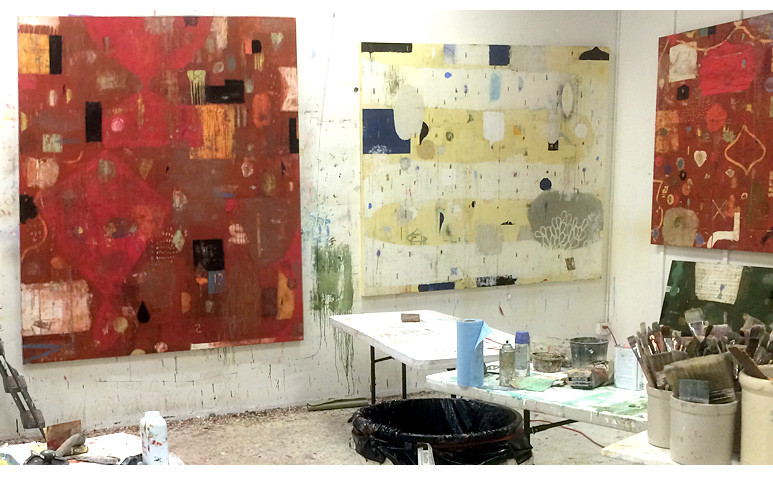
Nicholas Wilton’s studio about a week away from a solo show.
So how do you make your work hold up when it gets super big? I mean really big, like 8-10 ft. big. At that scale – or actually any time your work gets bigger than yourself – it can either fall down or be stupendous. Scale makes everything better or worse. I am asked frequently how to scale up work effectively by my students. I have written about this before, but since then, I think I have had some more clarification that has come from my own struggles with this issue.
Here are three points I keep in mind when I am making my art big.
#1 MAKE THE CLOSE UP VIEW AS STRONG AS THE DISTANT VIEW
When making art that is bigger than yourself, it is important that the art looks exciting, not just from close up, but also from across the room. Sometimes when our art is large, we stand right up close and get lost in all its detail. However, from a distance the viewer can’t see these subtleties. If it doesn’t look interesting from a distance then no one will spend the time walking across the room to look at it.
A strong work of art needs amazing detail, subtlety (I call this the quiet conversation) juxtaposed with bold, loud composition created by relative big differences in value contrast which makes it possible to see clearly from far away (loud conversation.) Both conversations need to be equally strong, however the former has slight differences in value and in the latter, big differences. Value, which is the degree of lightness or darkness of something, is primarily what controls these two conversations.
I like to think of how my art would look to someone driving by a gallery in a car traveling at 25 mph. If, in that one second, the loud conversation is compelling, then and only then will the driver pull over and come into the gallery to have a look at my work.
#2 SCALE UP YOUR TOOLS AND MARKS
When the work gets bigger, then so should the tools used to make that work. Imagine a 1” brush being used on a 12” square painting. The brush relative to the size of the art is quite large. Now if you make that 12” square painting 72” x 72” square, it has grown in scale 36 times! Taking a brush only slightly bigger, say 2”, will in no way be enough to generate a similarly powerful brushy feeling of the 12” painting. Basically, going larger with your tools will help you scale up the feeling you achieved in the smaller work.
Also, what might be a bold gesture, done with a twist of the wrist on a smaller work might not be enough once the work becomes larger. Your emotion and the physical movement of mark making will have to also grow in scale to pull off larger work. Larger tools will help you achieve larger work. And remember that to lose control and to invite spontaneity into a large work of art you must really embrace it to be noticeable.
In other words, practicing out of control in a corner that no one will notice isn’t really losing control. You know what I mean…I do this too. We need to step it up in a major way, in all ways, to pull off big scale.
#3 IMAGINE YOUR ART’S BOUNDARIES ARE BIGGER
When working on your Art, especially something at scale, it is important that you push yourself to think beyond the confines of the edges of your actual Art. Imagine that your art is merely a window into something bigger. Imagine you are creating a cropping of something that is bigger as you work. A shape that is made while worrying about the actual boundary of the art will feel small and self-conscious compared to one that can disregard the physical edges of the Art.
Imagine while you are working on your art that there is 12”or even 20” of border beyond the canvas. This is there for you to consider as well; it can be a runway for mark making to begin or end that will cross over or out of the actual art you are making. If you can play, work, like there are no boundaries, your art will feel more expansive. Sometimes I even let my brush paint on the actual studio wall outside the borders of the canvas.
Be expansive in all ways so that your art will not just look large but will feel large as well. It needs to be both.
Keeping these points in mind as you scale up really helps me.
What ways or thoughts do you use to make your Art bigger? Please comment below.
In gratitude, Nicholas

Hi! I’m
Nicholas Wilton
the founder of Art2Life.
With over 20 years experience as a working artist and educator, I’ve developed a systematic approach that brings authenticity, spontaneity and joy back into the creative process.
Join me and artists from all over the world in our Free Art2Life Artists Facebook Group or learn more here about Art2Life.