
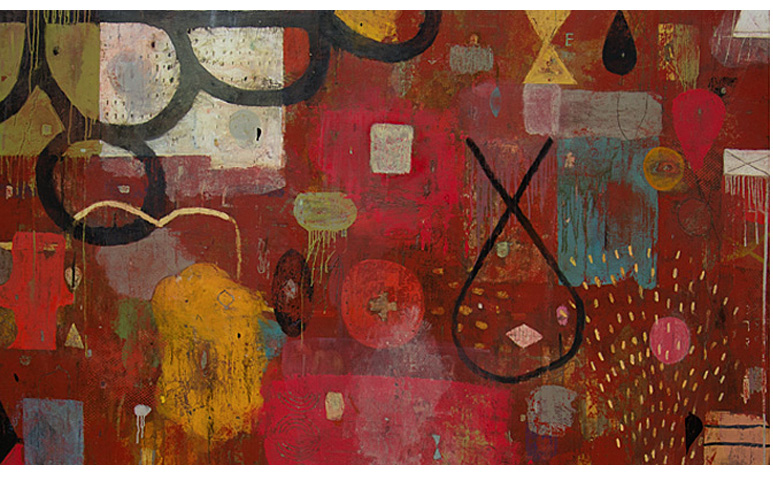
 When I teach workshops I always have people work on several paintings at the same time. That way when you gets stuck you can merely move on to another one. The idea being that if you can keep moving—even if it is on a different painting that this is a good thing. The flow state of making art is the critical thing to keep one’s attention on as it is this psychological space that allows strong art to occur.
But then I discovered something else about how the creative brain works…. and this was around making art when you are not really trying. It turns out, at least for me is that when you are not trying so hard, often you can make your best art.
Who hasn’t struggled for days, possibly weeks on something only to work on something else that is just for fun and it instantly becomes better than that piece of art that you have toiled on for days, and even weeks on?
What is going on?
If there are any shortcuts to making great art, then clearly this must one of them. If only we could do this all the time. It would make the process of art making much easier.
So now I always try to create this condition in my studio as well as my workshops. It has to do with what I call, the “throwaway board”. This is an additional 12’ x 12” board that is always sitting off to the side of the painting you are working on. When I am making small paintings in a workshop the throwaway board is also small but when I am in the studio and am painting larger then the throwaway board is large too.
The whole idea is that this throwaway board, (or canvas) is where you brush on your extra paint when you are changing your palette, or even just wiping extra paint off your brush. And yes it does end up looking pretty loose and raw but once you get in the habit of using this extra board, something interesting, over time, occurs.
The throwaway board becomes equally strong if not stronger than the actual board or canvas you are focused upon.
I don’t entirely understand what is happening but now after about a year watching this repeat itself not only with me but also with dozens of students, I have come to a few conclusions.
1 When we try less hard sometimes our intuition can more easily express itself. In art, more often than not, our intuition is right.
2 If some of the marks we make are not totally controlled or thought through then the resulting art has more spaciousness. This more easily accommodates different viewers interpretations of this art making it generally more accessible to more kinds of people.
3 Because there is little or no pre-thought to what you are making on the throwaway board, only present moment spontaneous decisions to make a certain mark in a certain place, it makes the whole process super fast and incredibly effortless.
4 And of course last but not least, this painting off to the side of what you are painting really does make art that is strong. The last exhibitions I had, both had paintings that were derived from “throwaway” paintings. They were, in the end, the paintings I felt most apprehensive about at first but over time, realized they actually were amongst the strongest paintings I had made. Interestingly, both sold opening night and both were instrumental in giving me guidance as to where my work should be heading long after I made them.
Now, I can’t imagine art making without having a spare painting in my process with every painting I make. It has become that important to my process.
So maybe try this for yourself. Who knows, it could be that shortcut to your best art you never knew you could make.
I am curious about how this phenomenon shows up in your practice. Do you take advantage of it? Share your thoughts and comments here.
5 Comments
Hi! I’m
Nicholas Wilton
the founder of Art2Life.
With over 20 years experience as a working artist and educator, I’ve developed a systematic approach that brings authenticity, spontaneity and joy back into the creative process.
Join me and artists from all over the world on our Art2Life Instagram account or learn more here about Art2Life.
I’ve taught meditation since 1980. so I approach my painting practice as a meditation practice. each canvas is the first canvas: fresh, new, with no expectations. this way, I don’t get caught up in having to make “the best painting.”
I had to smile reading your note today! It is so describing for the prosesses I always fall into. I started having “throwaway boards” and that is where the magic starts showing itself. I try to keep the same lack of thinking and critical thoughts in the “main” paintings, but it is an ongoing excercize.
I also want to thank so much for your inspiring blog! I am hoping to save up enough money so that I can attend your course next time around.
Love this idea and I have had it happen to me as well! It’s funny how the art we put the most thought into can sometimes result in our weaker pieces, and vice versa. 🙂
Right! I always love the palette paper, the accidents, the peripheral incidental, the floor. Somehow removing oneself from the thought process is key, but not easy! If
98% of the time, my throw away is better and I end up using it as the perfect background